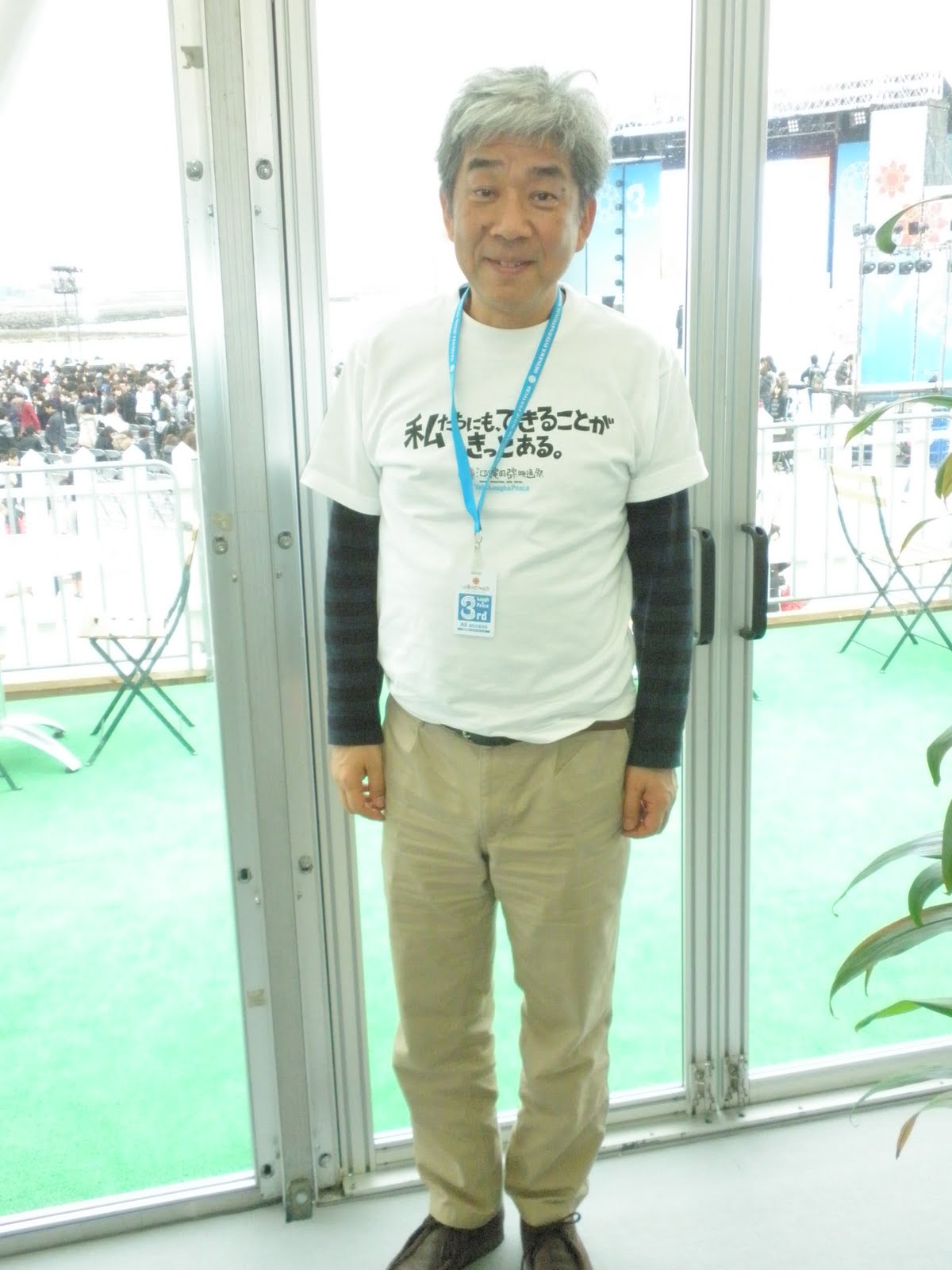
Interviewed for BC magazine.
Tony Hawks's first film, based on his travelogue novel of the same name, Round Ireland with a Fridge was selected for the Okinawa film festival's peace section. Naturally, Tony was not alone upon arrival and in tow was the fridge that began it all. Film in Japan had a chat with him about his film, and the challenges of turning his best-selling book into a screenplay.
FIJ: Most of the foreign guests withdrew from the festival in the light of the events in Tohoku. What made you decide to come?
TH: Had a look at the map and thought well, this is safe. And it seemed like a good time to come at a time like this. People just panic I think.
FIJ: For those who haven't heard of Round Ireland with a Fridge could you give them an idea of what it's all about?
TH: It's based on a true story, something that I actually did just over ten years ago, and the reason I did it was because of something I did about fifteen years ago on my first trip to Ireland. I was being driven in a car to this place Cavanagh, and I saw this old man by the side of the who was hitching with a fridge. I said to the driver, "Was that a guy hitching with a fridge?" and he went, "Oh, yeah." and he just never talked about it. I thought Ireland is an incredible place that someone who's hitching with a fridge isn't considered a conversation point.
I used to tell this story at dinner parties and then at one I said that Ireland is the one place in the world where you could hitch with a fridge and people would stop for you. A friend of mine said it wouldn't be possible. We drank a lot of wine, and I made a bet with him that I could do it. So I took a month off, bought a fridge and stood by the side of the road in Ireland. Spent a month there, had this incredible adventure, wrote about it and then people started approaching me about making it into a film, and that's what we've finally done.
FIJ: How does it feel to be bringing RIWAF round Okinawa?
TH: Well it's fantastic, there are moments when it's very surreal, because [the festival] is sponsored by different comedians and I don't know what they're saying and they are dressed in exotic costumes, and messing around. But it's fun and they are all very nice. There is a big generosity around them.
I suppose the wonderful thing about film is that you can reach another audience. I'd never be able to tell this story in Japan in any other way. The subtitles go up, and people watch, and you think, Wow people half way around the world are following this little silly story.
FIJ:That kind of answers my next question, why did you decide to make this into a film?
TH: Well the real reason was I started to receive a couple of emails dropping in via the website from producers saying, "Have the rights gone?" That makes you think, "Oh wow!" I didn't think there could ever be a film. Then I watched Straight Story a David Lynch film about a guy who goes around America on a lawnmower. I went to see that film, and not a lot happens in it. It's just a sweet film and I thought, well if they can do that then yes we have got enough to do this as a film. So I started thinking about how it could work as a screenplay and it kind of went from there.
FIJ:So was it difficult to adapt?
TH: It was, partly because it was the first time I'd ever done anything like that, and secondly because it's my experience, that I really had. But, I knew I had to change a couple of things. I really wanted to keep the spirit of the truth there, but you know, sometimes you have to combine two characters into one, and so on. The love story is a bit different, there's a a little romance in the book that nearly happens, but it happens a bit more in the film. So it was difficult. The hardest thing was people who kept reading the screenplay, kept saying we need to see more of a journey, more of a change in the lead character. That's the big difference in the film, that I actually portray myself as more of an arsehole than I really am. Well, at least I think so.
FIJ:I'm sure
TH: There's more of a healing process around the journey, a three act structure. But you thought you've got do it, and I think it works, well I hope it does anyway. We'll have to see.
FIJ:What was it like acting as yourself? I imagine that might be quite difficult?
TH: I think a lot of actors do in a way play themselves. If you think of Hugh Grant he kind of is him in his films, just with a different name. So an actor will always bring their own personality to a role, unless they're a really traditional actor and have to learn a dialect or something .But, very often the big famous stars, pretty much just turn up and say the lines. I suppose I was able to remember how I felt when things happened. It's odd in that you are playing yourself in a dramatic reconstruction of something you actually did. But, you just get on with it, really...
FIJ: Was it your first experience acting?
TH: Not really. I've done a few stage plays and a few TV things. But it was enough, because it's good to know how to carry on when there's a camera in your face. Not to panic or get scared. Some actors that you work with, you realize that it's sometimes quite a good idea not to tell them that you're filming because they do really well in rehearsal, and you say, "Okay let's do a take." and it doesn't come out so well. So sometimes you give a wink to the cameraman and say get this one.
FIJ:Were any of the rest of the cast real people, so to speak?
TH: Well, actually they were all actors. We did think of getting some of the real people. We shot quite a lot of the interior locations in London in Irish pubs. We found that pubs in London look more Irish than Irish ones. On the DVD extras though, we've got an interview with Antoinette, the character we based Roisin on. I still see them all but we didn't cast them in the film.
FIJ:How's their reaction been to the film? Do they approve of their celluloid versions?
TH: Yeah they like it I think. Bingo [the character who persuades Tony to go surfing and bring his fridge along] hasn't seen it yet. He rings me up and asks when I'm going to send him a copy. But I keep forgetting.
FIJ:Getting a fridge to surf in the first place looks incredibly difficult. Filming it must be immensely so?
TH: We did it exactly the way we did it in real life, which is literally put it on a surfboard an wait for the right wave to come along. It does just surf. Ed the director was saying I don't think this will work, and I was saying trust me it will. So that relief you see with me waving my arms in the air was a genuine moment, it wasn't really acting. That was great fun that day. It was a beautiful day, just being in the sea and arsing around with a surfboard and a fridge all day was great, just great. Because some days aren't, some days are really boring as hell. The rain starts and you're wet through. It's cold, and the winds blowing, you're shivering, and teeth chattering, then you have to go again. Like the opening ceremony to this festival.
FIJ:Ed Byne did a great job capturing the Irish countryside. How did he get on board with the project?
TH: I worked with him on Red Dwarf. He was the director and that's where I first started doing little bits of acting. I was in about four of them as Caligula. It's a big project when you take on a film and I was thinking I want someone that I know I'm going to get on with, who understands comedy. He popped into my head and I hadn't spoken to him for ages. Just rang him up out of the blue and said, "Ed, I'll send you this thing, see what you think?". And he was a good choice. He's genuinely a really nice guy, and that's important I think. A lot of films seem to be clashes all the time and didn't want that. I think he did a great job.
FIJ:It's your experience, so how was it like being directed by someone?
TH: Ed was very good. He'd sort of say, "I think it should be like this, but you tell me what you think." Every once in awhile I'd go to him and have a quiet word and say, "I don't think they should be reacting so strongly." or something. He's without an ego so he didn't mind. Most of the time he just understood it naturally, but if there was a little problem just had a word. Most of the time anyway all he was saying was, "Can you just say that a bit louder please?" It's a good job being a director!
FIJ:Some people have labelled the criticism that the Irish characters are perhaps cultural stereotypes? How would you respond to that?
TH: I think with that, in a way you're in a no-win situation. Irish people, particularly, are very very sensitive about this. When I wrote the book I was expecting that but actually, it didn't really happen. Because it was true and I was writing about how people are. Irish people themselves make fun of stereotypes, and it is true that there is going to be a certain type of character who's going to be like that. And it is true, obviously, that you're going to write about the people like that, rather than the people who are exactly like you. They are not as interesting. Those people do exist and people expect to see it. But, I don't think it's as strong as it can be in some American films, where they really are over the top. There is nothing in there that isn't based on exactly how Irish people were around me and the fridge. So I would just refute that allegation, they're just wrong! (laughs)
FIJ:Could you tell me what Fridge D'Or is?
TH: It's a jokey name for the company we made to make the film. I found various people to put money in, and then formed a company. It's called an EIS scheme, which is enterprise initiative scheme, a good tax-break. We thought Palme D'Or, Fridge D'Or. Normally, you make a company for each individual film and that was for RIWAF. I don't have any plans to start Fridge D'Or into a full on production company.
FIJ: In your own words what does the philosophy, "Have faith in the fridge." mean?
TH: I suppose what it is really, it's like trusting that things are going to work out okay, without necessarily needing to know exactly what it is that's going to make that happen. I think human beings have a sort of desire to say, "I need to define what this is, this is god, this is this..."and so on. So actually if you live you're life in the right way, without fear, without endlessly worrying about stuff, it'll actually pretty much work out okay. If you embrace that, doors will open for you. I kind of said it on the original trip as a joke, "I'll be alright, I've got the fridge with me." So I started to say it as a joke, and then I started to realize that by thinking and talking like that it all was okay. You do have to have some kind of faith in it, and good things will happen.
FIJ:How has it affected your life?
TH: It's sort of worked. It's a bit like having a faith without really needing to be religious. It's about fear, which is the enemy to our progress. There's a little voice saying, "What if you do that? What will happen?" And people sometimes say I'm a risk taker, but I don't think I am. I always sit down and say what's the worst that will happen here, am I okay with that if it happens? If you are okay with that, then you do it. It's just fun, it's life. It can be more fun than it is for a lot of people because everyone, your mum, your grandparents, your friends are saying, "No, don't do that! You'll lose your pension, you'll lose your..." Throw all that off and just dive into the pool!
FIJ:So you had all these pressures when you took that decision to off with the fridge?
TH: Well, that's the slight difference. I think in reality, I was already the kind of person who would've done that anyway. The film is telling the story maybe of someone who wouldn't have done that, and circumstance made them do it. I was already in real life saying, Ireland is the place you could do this, I believe that. That's what made the screenplay difficult because if I'd done that in the screenplay the change in Tony was over before it had even started. So we had to have a character who was not going to really enjoy it at the start and want to call it a day. That was the change.
FIJ:On a more general topic comedy is one of the harder things to translate culturally. What's been your opinion of some of the comedy you've seen here?
TH: You're absolutely right. You simply can't make a proper judgement on it. I speak French and I go to France quite a lot, and I still don't get French comedy. I don't understand it at all. It seems big, and surreal. Then we do have our Monty Python, and Americans might have looked at that and thought it was completely weird. I'm going to see Omu Raisu [the new film from Yuichi Kimura]today, so we'll see.
FIJ:Have international audiences reacted to the film differently?
TH: We met the Japanese jury and they all seemed to really love it. It did well in America. So I think, touch-wood, it has a kind of international appeal. It's very gentle, too. It's not going in demanding belly laughs. It's actually going in and saying here's a story. It doesn't have to be defined as a comedy really. It's just a drama. Hopefully, you'll smile at some bits, and laugh at others. That's your choice.
FIJ:On that logic, do you think it's appropriate that it was put in the peace section, as apposed to the laugh section?
TH: I know the book was billed as a comedy book. It does make people laugh and I was tring to be funny in it. But, I've always felt that the story and its message is quite a positive thing. There's a letter in the film saying, "I'm growing to like this. You put your fridge by the side of the road, stick out your hand, and you trust that someone will come along and help you," and they do because people are nice. That's really not a message that get's waved in front of you very often. What you do hear is people are out to rip you off, people are out to take advantage of you, but it's not really the truth. There's a small percentage that might, but even if you behave in the right way around them they might behave differently to you. You go in, and if you behave openly and generously to them, then they'll behave differently to you. That's the message I wanted to get across.
FIJ:What do you have coming next?
TH: There's a film festival in Paris which we're headed to. But, the second book I did Playing the Moldovans at Tennis, which is based on another wacky bet that I had to play the entire Moldovan football team at tennis one by one. That's shot, and we're editing that now. It's at that sort of scary stage. You've got all the pieces, but you have to assemble it it. Hope it works!